
Why Hands Matter in a Digital Age
Why Our Brains Need the Art of the Hand
Watch a potter center clay for the first time. The hands press down, and then in, and then the clay begins to rise. It is not a gesture you learn so much as one you remember. Your body seems to know how before your mind catches up.
There is a reason for that. And science is only now beginning to articulate it.
The Brain That Makes
Unlocking Creativity Through Touch

Neuroscientists studying the effects of hand-making—pottery, weaving, woodworking, drawing—have found something quietly astonishing: the act of creating with the hands activates the same neural networks as listening to music and practicing meditation.
The prefrontal cortex quiets. The default mode network, associated with rumination and anxiety, dims. The body shifts into a state that closely resembles rest, even while the hands are busy. This is not a metaphor. It is measurable, reproducible, and in clinical settings, increasingly being used as a therapeutic tool.
The explanation lies partly in attention. Hand-making demands a particular kind of focus—not the scattered, fractured attention of a screen, but a single, sensory, present-tense awareness. Your eyes are on the clay. Your hands are reading it. You are nowhere but here. Psychologists call this state flow. Makers have called it many other things—meditation, prayer, being absorbed, losing track of time. It is the same state, and it is one the nervous system appears to actively need.
Our brains are wired to respond to the tactile world. Engaging in hands-on activities like pottery not only enhances creativity but also strengthens neural pathways. The act of shaping clay connects us to our primal instincts, fostering a sense of accomplishment and peace. As we mold and form, our minds find clarity and focus, illustrating the profound impact of tactile experiences on our cognitive functions.
What the Hand Knows: Embodied Cognition
There is a concept in philosophy called embodied cognition—the idea that the mind does not exist only in the brain, but is distributed throughout the body, including the hands.
The hands are not simply instruments the brain directs. They think. They remember. They solve problems in ways that bypass language and analysis entirely. Surgeons know this. So do pianists, sculptors, and chefs. The hand carries knowledge that cannot be written down or transferred through instruction. It must be built through repetition, through failure, through the slow accumulation of tactile understanding.
A potter who has thrown ten thousand bowls knows things in their hands that cannot be fully taught to someone who has thrown ten.
This knowledge lives in the motor cortex, in the proprioceptive system, and in the fine-motor pathways that connect fingertip sensation to memory. It is older than language. It is the kind of intelligence that developed over hundreds of thousands of years of making things—flint tools, woven baskets, fired clay—and it is genuinely irreplaceable.
No machine has hands in this sense. A machine can replicate a shape with extraordinary precision. What it cannot do is adapt, feel, respond, or decide mid-gesture that something is wrong and correct it before conscious thought has even registered the problem. The hand does this constantly. It is, in this respect, a kind of genius.
Occupational therapists have noted a pattern that has grown more pronounced over the past two decades: people who spend the majority of their time in screen-based work often report a pervasive sense of disconnection. Not sadness, exactly, but a kind of “flatness.”
Many of them, when introduced to hand-making in any form, describe an immediate and surprising sense of aliveness—of being present in their own body in a way they had not realized they had been absent from.
The Evolutionary Imperative:
-
Ancient Infrastructure: Humans have been making objects for at least 29,000 years (starting with the earliest ceramic figurines like the Venus of Dolní Věstonice).
-
The 1.5% Gap: Until the last 150 years—less than 1.5% of our history as a species—human survival depended almost entirely on hand-dexterity.
-
Sensory Deprivation: The brain that does not make things is a brain missing a kind of stimulation it evolved to receive.
This is not coincidence. The brain that does not make things with its hands is a brain that is missing a kind of stimulation it evolved to receive. We are a species that has been making objects for at least 29,000 years — and likely far longer. The neural infrastructure for it is ancient, deep, and evidently not optional. When we stop using it, we feel its absence. This is not an argument against technology. It is an argument for balance — for returning some portion of our time to the kinds of making that keep us in our bodies, in our senses, in the present tense.
Why a Handmade Object Feels Different?
There is a phenomenon researchers call the IKEA effect—the tendency for people to value objects they helped create significantly more than identical objects made by others. People love what their hands have touched.
But this works in the other direction too. When you hold a handmade object—something made not by a machine but by a real person’s hands—there is a transfer of presence that is not entirely imaginary. The object carries the physical decisions made during its creation: the pressure applied here, the tilt held there, the glaze chosen after consideration. It carries the trace of a nervous system not unlike your own.
Psychologists have shown that holding warm objects—particularly rounded, smooth ones—activates the same neural pathways associated with human warmth and social connection. A ceramic cup, held with both hands, a hot drink inside, does something to the nervous system that a plastic cup cannot replicate. The weight. The temperature distribution. The slight irregularity of a handmade surface that the fingertips register and interpret as presence.
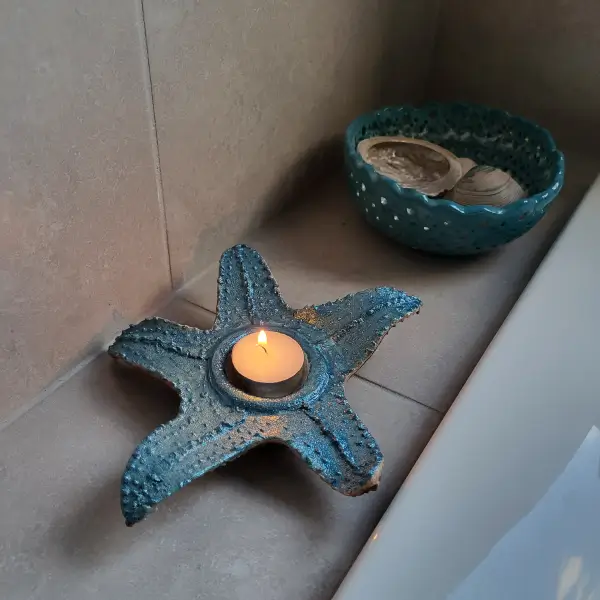
This is why objects made by hand feel different. Not because of aesthetics alone, but because of what they literally do to the body that holds them.
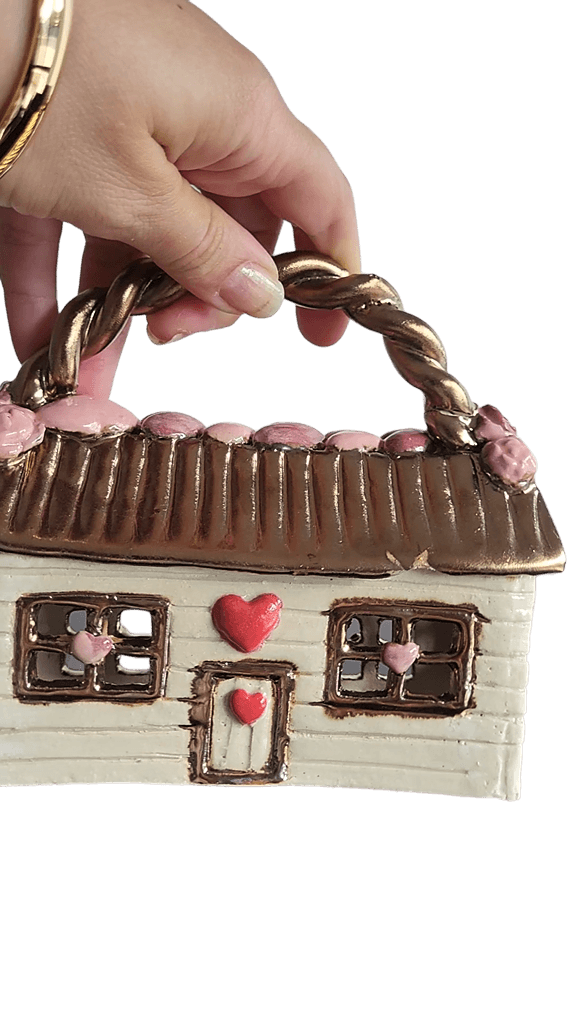
In my garage, I find my work waiting for me whenever the world finally goes quiet and I find a pocket of free time. It isn’t a grand studio; it is simply a space where the noise of the day-to-day stops. There is something about the transition from the concrete floor to the cool dampness of the clay that feels less like a task and more like a necessary restoration.
I don’t fully understand the mechanics of it, but I know it from the inside: the mental clutter of a busy life settles the moment my hands are occupied. Something clarifies. By the time I step back into the house and the first vessel of the session is drying on the shelf, I feel more like myself than I did when I walked out.
Neuroscience is building the vocabulary to describe what this is. But the potters who came before us—the women shaping clay in ancient Jomon Japan or the craftspeople of Crete who built massive pithoi jars by hand—they already knew… This knowledge was held in their hands long before it was ever written down.
Today, on National Handmade Day, I want to make a quiet case — not for buying handmade, though that matters — but for making something yourself! Anything. Clay if you can find it. Bread. A letter written by hand. A garden bed dug by your own effort. Some act that brings your hands into conversation with the physical world and asks your mind to be present for it.
The hand is not obsolete. It is not romantic. It is not inefficient. It is, in the deepest sense, what makes us who we are — and we lose something when we forget to use it.
And if you would like to hold something made by hand— to feel that presence of a human trace — the Kinsella-Art collection is made slowly, one piece at a time, in a small studio by someone who still believes the hand cannot be replaced.