
Clay: The Oldest Material on Earth
Imagine a pair of hands pressing into soft earth. It is not 2026. It is not even the ancient world as we tend to picture it — no temples, no cities, no writing. It is 27,000-31,000 years ago. A fire nearby. And someone, somewhere, is shaping clay into the figure of a woman. And a child who touches it, before the figurine is fired.
That figure was discovered in 1925 in a layer of ash in what is now the Czech Republic. We call her the Venus of Dolní Věstonice. She is 11 centimetres tall. She was fired at low heat — between 500 and 800 degrees C— and she has survived nearly 30,000 years! She is not a storage vessel or a cooking pot, she is not practical. She is art. She is wonder made permanent in earth.
This is where ceramics begins. Not in utility. In feeling.
Before pottery, there was clay…
Most people assume ceramics started with cooking pots and storage jars — practical objects born of necessity. But the oldest ceramic objects tell a different story. The Venus of Dolní Věstonice predates the first pottery vessels by roughly 9,000 years. The first human impulse with clay was not to store grain. It was to make a figure of a woman.
Alongside her, archaeologists found hundreds of other clay figurines — bears, lions, mammoths, foxes, owls — and more than 2,000 balls of burnt clay. Near the remains of a horseshoe-shaped kiln. Someone was experimenting. Learning what heat did to earth. Discovering, perhaps by accident, that fire could turn something soft and yielding into something that would last.
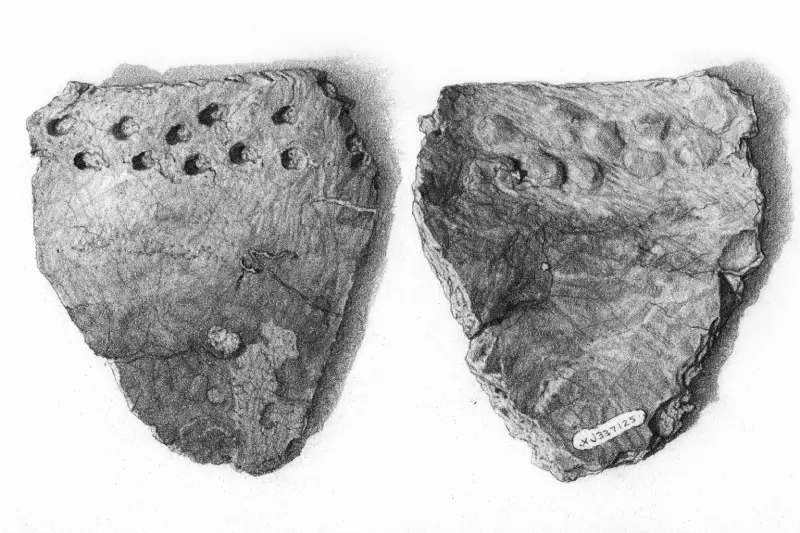
The oldest known pottery vessels came later, from Xianrendong Cave in the Jiangxi province of China, dated to around 20,000 years ago. What makes this discovery extraordinary is the timing: these pots were made by hunter-gatherers, long before farming and settled villages. For over a century, archaeologists assumed pottery and agriculture arrived together. These Chinese vessels overturned that assumption completely.
In Japan, the Jomon people were making pottery by at least 14,500 BCE — and the word “Jōmon” (縄文) means “rope-patterned,” named for the impressions they pressed into wet clay before firing. The texture of rope. The mark of a human hand. A gesture made 16,500 years ago, still visible today.
What clay does to the human body
There is science behind the pull of clay — and it is quietly remarkable. Researchers studying the therapeutic effects of working with clay found something unexpected: participants who shaped clay with bare hands showed measurable improvements in mood and wellbeing immediately after the session. Those who wore gloves? No improvement at all. The effect was entirely mediated by direct skin contact — the temperature of the clay against the skin, its weight and resistance, the way it gives.
When we press our hands into clay, thousands of touch receptors fire at once. The parasympathetic nervous system — the one responsible for rest and calm — responds. It is, in a very literal sense, grounding. The earth in your hands tells the body it is safe. Something settles.
Italian researchers have a phrase for ceramics that has always stayed with me: la plastica dell’antichità — the plastic of antiquity. The original material that could be shaped into anything. Before synthetic polymers, before refined metals, before glass — there was clay. Everywhere, always patient, endlessly responsive to the human touch. Our oldest collaboration with the earth.
Perhaps this is why throwing a pot or hand-building a bowl can feel meditative. Not metaphorically — physiologically. The hands are busy, the mind quiets, the body enters a state that resembles rest. Working with clay activates the same neural pathways as music and meditation. We have known this intuitively for 29,000 years. Science is only now putting words to it.
Source: “Effects of Tactile Experience During Clay Work Creation in Improving Psychological Well-Being” Published in: Art Therapy journal, 2019, Volume 36, pages 192–199
Clay across the ancient world
Ceramics did not arise in one place and spread outward. It arose in multiple places, independently, because clay is everywhere — and the human impulse to shape it appears to be universal.
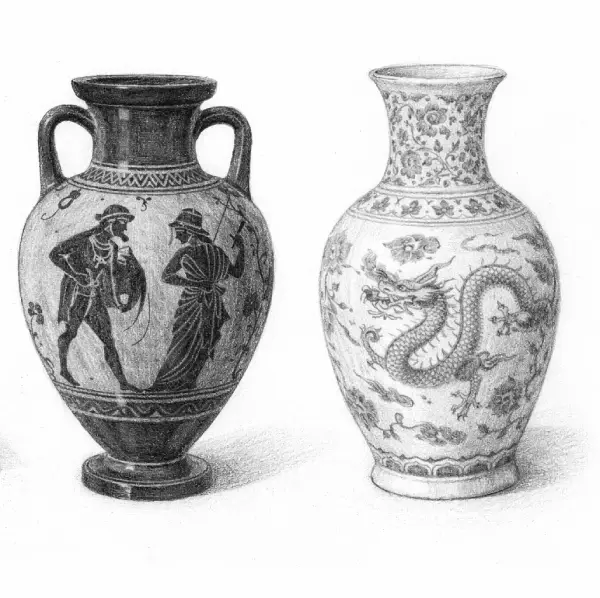
In ancient Egypt, craftspeople developed faience — a glazed ceramic composite used to make amulets, figurines, and ritual vessels in turquoise blue. In ancient Greece, potters developed the black-figure and red-figure techniques, painting scenes from mythology and daily life onto vessels that now rest in museums across the world. In China, 20,000 years of ceramic tradition eventually gave rise to porcelain — so luminous and refined that European potters spent centuries trying to reverse-engineer it, never quite succeeding.
In the Minoan culture of ancient Crete, potters painted octopuses and sea creatures in fluid, naturalistic strokes — coral, starfish, triton shells, sponges — using the curved surface of each vessel as a kind of ocean floor. These pots are 3,500 years old and feel shockingly contemporary. And in Japan, the Jomon tradition continued for over 10,000 years, the longest unbroken ceramic tradition in recorded history.
Across every culture and every era, clay held what mattered: food, water, ritual, memory, prayer, story. And it preserved those things across time in a way no other material has. A ceramic fragment is virtually indestructible. A bowl broken in ancient China 10,000 years ago still exists — in pieces, perhaps, but still in the world. In this sense, ceramics is not just art. It is the most durable record of human life we have.
The first International Day of Ceramics
This year, quietly and without much fanfare, something happened for the first time in history. On 12 March 2026 — just passed — the world observed its first ever International Day of Ceramics. Established by the Japan Fine Ceramics Association, the International Ceramic Federation, and partner organisations around the globe, the day was created to draw attention to how deeply ceramics runs through all human life: through history, through science, through the home, through the nervous system.
It is a small thing in some ways — a named day, a marker on the calendar. But there is something meaningful in the timing. After 29,000 years of humans pressing their hands into earth — making figures, making pots, making meaning — there is now a day set aside simply to notice it. To pause and recognise what has always been there.
Ceramics has never become obsolete. It has never gone out of use, never been replaced, never needed to reinvent itself. From the first Ice Age kiln in Moravia to a studio potter in Bendigo shaping a fruit bowl by hand in the morning light — the gesture is unbroken. The same warmth of clay. The same yielding weight. The same quiet transformation between the hands.
There is something in working with clay that feels less like craft and more like memory. A memory that lives in the hands before the mind catches up. The pull of it is older than language, older than agriculture, older than almost everything we think of as civilisation.
Perhaps this is why a handmade ceramic object on a kitchen table feels different from one made by machine. Why the slight unevenness of a thrown bowl, the fingerprint left in a glaze, the soft weight of something made slowly by a real pair of hands — why these things matter in ways that are difficult to explain but easy to feel. They carry time. They carry the trace of a person. They ask you to slow down just by being there.
Clay is the oldest human-made material on Earth. And it is still, nearly 30,000 years later, one of the most intimate things we know how to make.
If this story of clay and time speaks to you — explore the handmade ceramics collection at Kinsella-Art. Each piece is shaped by hand, made slowly, and sent out into the world to find its home.