
A Guide to Understanding Stoneware
High Fire- Mid Fire Stoneware
You’ve just discovered a beautiful handmade ceramic mug. The glaze is perfect, the shape fits your hands, and you can already imagine your morning coffee in it.
But then a small doubt appears: Will it survive the dishwasher? What if it chips the first time I use it?
These are common questions when buying handmade ceramics. The durability of a piece often depends on two important factors: the type of clay used and the temperature at which it is fired in the kiln.
In this article, we explore the differences between mid-fire and high-fire stoneware, and how firing temperature influences strength, durability, and everyday use.
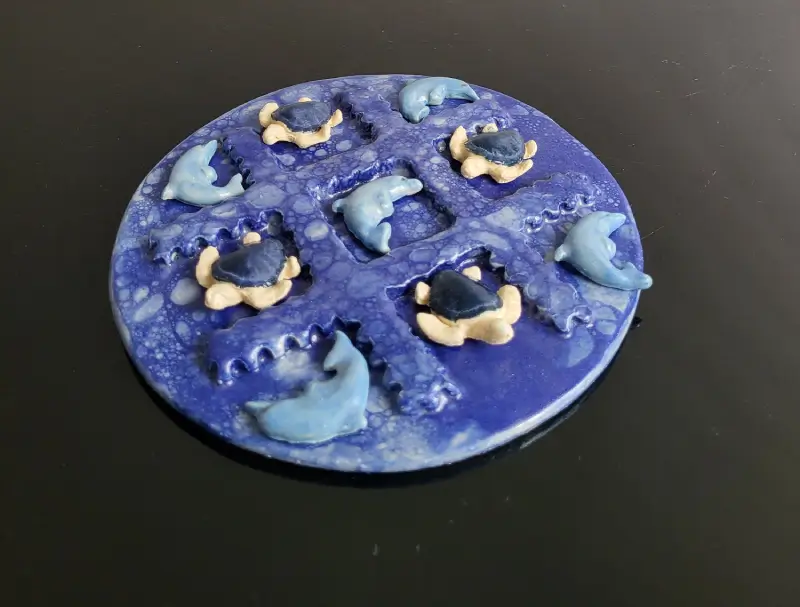
Choosing the object made with the right type of clay can make a big difference in your everyday use. High-fire stoneware clay is incredibly durable with a refined finish, making it perfect for robust, long-lasting pieces. Its ability to withstand very high temperatures makes it ideal for functional items like cookware and dinnerware.
On the other hand, mid-fire stoneware clay offers a versatile option that balances strength with ease of use. It’s especially popular for its wide range of glaze possibilities and vibrant colors, making it a favorite for decorative or artistic pieces.
The primary difference between mid-fire and high-fire stoneware comes down to firing temperature. Think of firing clay like baking a cake—but instead of 30 minutes at 180°C, we’re talking about 16+ hours at temperatures between 1 280°C to 1,300°C. Potters call it cone 10 firing.
- What happens: Clay particles completely vitrify (turn glass-like), fusing into an incredibly dense, waterproof material
- Characteristics: Completely non-porous, extremely durable, thermal shock resistant
For MidFire the objects are fired at so called cone 5-6. The temperature of firing is lower: 1160°C – 1240°C
- What happens: Clay particles fuse together, creating a somewhat durable ceramic
- Characteristics: Can be slightly porous, less dense, more prone to micro-cracks over time
The difference of 40-120°C might not sound like much, but in the world of ceramics, it’s transformative!
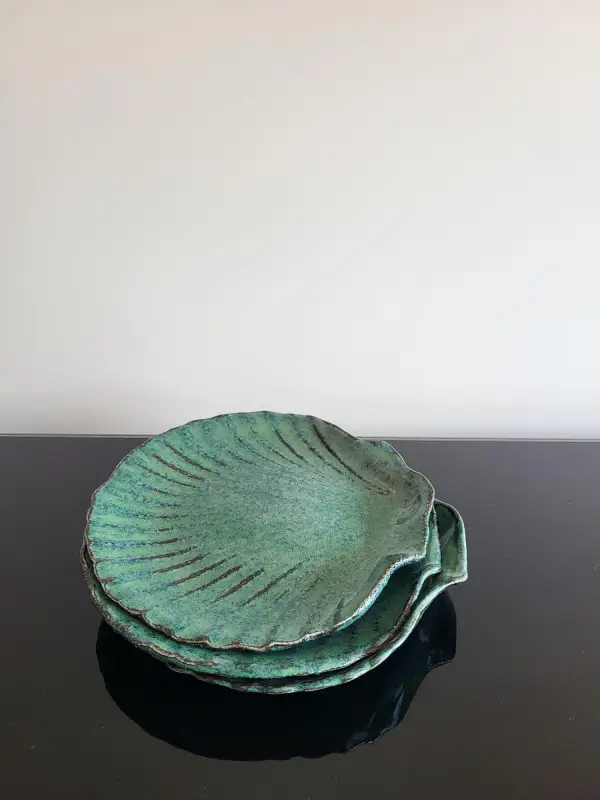
High-Fire Stoneware
Known for its durability and resistance to water, high-fire stoneware is ideal for functional pieces like dinnerware and cookware.
Mid-Fire Stoneware
Offering a balance between strength and workability, mid-fire stoneware is perfect for decorative items and intricate designs.
Why I Choose High-Fire / Cone 10 for All My Functional Pieces
When I first started making ceramics, I experimented with different firing temperatures. I quickly learned that if I was going to create pieces meant for everyday life—pieces you’d reach for every morning, wash in the dishwasher, and use for long time—I needed to fire at cone 10.
Here’s why:
1. True Waterproofing
At 1280°C, the clay body vitrifies completely. This means the microscopic spaces between clay particles disappear, creating a solid, glass-like structure throughout the piece.
What this means for you: No water absorption, no staining from coffee or tea, no bacterial growth in tiny pores. Your mug stays pristine and hygienic for years.
2. Dishwasher Safe
This is the question I get most: “Can I put this in the dishwasher?” With cone 10 stoneware, the answer is an emphatic yes. It is dishwasher safe, but hand-washing is advised to preserve your object for longer time.
The combination of vitrified clay body and high-fire glazes creates a surface that can handle:
- Hot water cycles (up to 70°C)
- Detergent chemicals
- The impact of water jets
- Repeated thermal cycling (hot to cold, cold to hot)
What this means for you: Load it in the dishwasher with zero guilt. Life is busy enough without hand-washing every dish.
3. Chip-Resistant Durability
The density created at cone 10 means:
- Surfaces resist scratching from utensils
4. superior Thermal Shock Resistance
Ever had a ceramic mug crack when you poured boiling water into it? That’s thermal shock—the material expanding unevenly and splitting.
Cone 10 stoneware has already survived such extreme heat in the kiln that your boiling kettle is nothing in comparison.
“But Isn’t High-Fire More Expensive?”
Yes and no. Firing to cone 10 uses more energy and takes longer. The kiln runs for about 14-16 hours per firing, versus 10-12 hours for mid-fire. The failure rate is also higher—pieces can warp, crack, or develop glaze defects at extreme temperatures. But on another hand this piece will live a longer life.
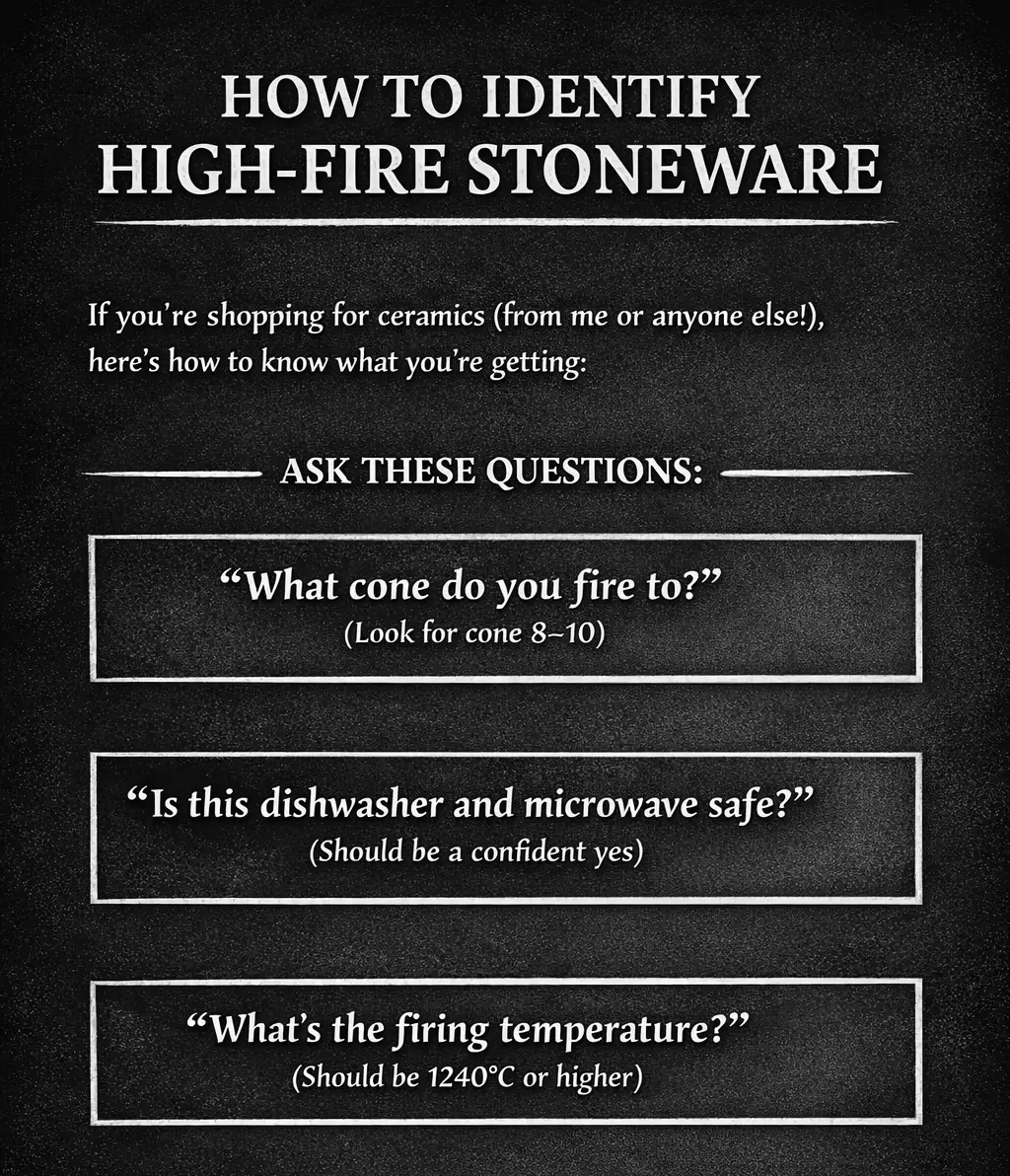
My Firing Process: A Glimpse Behind the Kiln Door
Every piece I create goes through this intensive journey:
Day 1: Throwing or hand-building
Days 2-7: Slow drying (rushing this = cracks) Day 8: Bisque firing to 950°C (10 hours)
Days 9-10: Glazing by hand
Day 11: High-fire to 1280°C
Day 12: Slow cooling (12 hours—opening too early = thermal shock)
Total time: Nearly 2 weeks from wet clay to finished piece.
That’s why handmade ceramics cost what they do. It’s not just labor—it’s patience, expertise, energy, and a high failure rate. But when a piece emerges perfectly from that final firing, with the glaze fully matured and the clay body completely vitrified, it’s absolute magic.
Want to see the firing process? Follow me on Instagram @artkinsella for behind-the-scenes studio content.
Looking for something specific? Get in touch about custom work.